
When people talk about large abstract paintings, they usually mean size.
Big canvas. Big wall. Big impact.
But scale on its own doesn’t do much. It can fill a space, but it doesn’t necessarily hold it.
A painting becomes monumental when it has presence—when it continues to shift, reveal, and hold attention over time. That has less to do with size, and more to do with what’s happening inside the surface.
A work like begins to show this.
Waters of Life
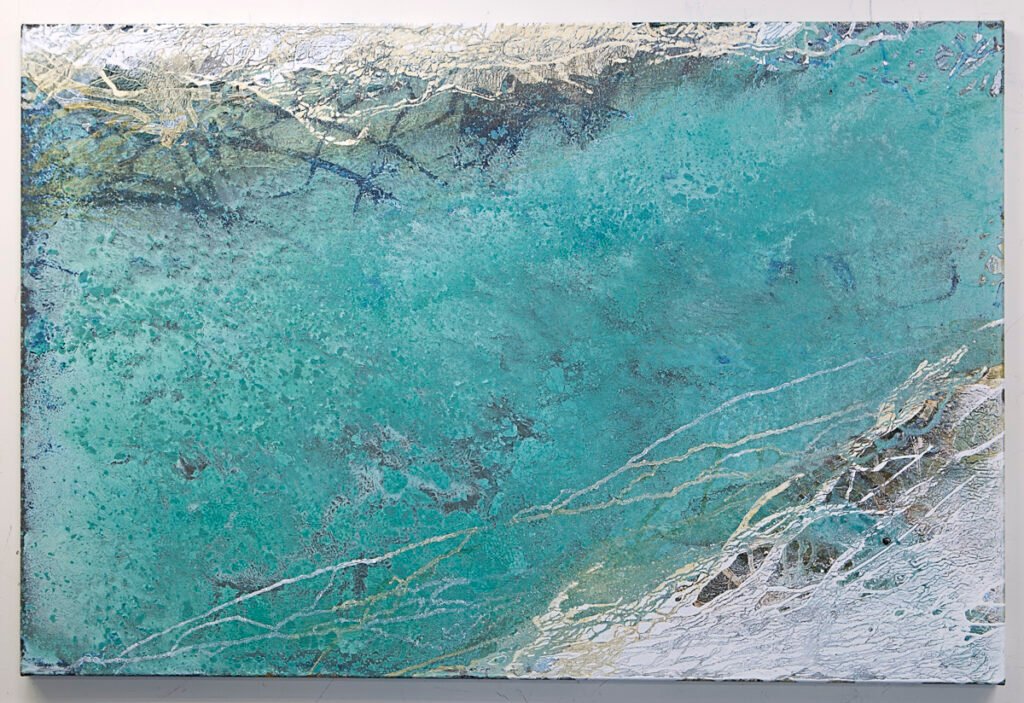
48 x 72 inches — oxidized metals and limestone on canvas
Built through oxidized metals and limestone, the surface holds both density and movement. Light catches unevenly across the material, creating shifts between opacity and reflection. The work doesn’t rely on scale alone—it builds presence through surface, weight, and the way it continues to change under different conditions.
What Makes a Large Abstract Painting Actually Work
A large painting can dominate a room immediately. The harder thing is for it to stay interesting after that first encounter.
That comes from:
- material depth
- chromatic tension
- surface complexity
- and how the work responds to light
Without that, scale is just volume.
With it, the painting becomes something you live with, not just look at.
Surface Is Not Background
In these works, the surface isn’t a place where something is painted—it is the structure.
Built through mineral layering, metal pigments, and controlled patina, each piece develops over time. Layers are added, partially concealed, and reworked. What sits on top is always in conversation with what’s underneath.
Blue may begin as mineral pigment, shift through oxidation, and settle somewhere between turquoise and lapis. Metallic elements catch and release light depending on position and time of day.
Nothing is flat. Even when it appears still, it isn’t.
Light Changes Everything
A lot of contemporary abstract art is static—you see it once, you’ve seen it.
These works are different.
They are light-responsive. As light moves across the surface, it refracts, absorbs, and shifts. Areas that appeared dense open up. Color relationships change. Depth appears and recedes.
Morning light, evening light, artificial light—each alters the work.
The painting is not fixed. It is conditional.
Not Instant. Not Obvious.
There is no single focal point directing the viewer.
Instead, the experience builds over time.
You notice something, then something else. A surface resolves. A color relationship becomes clear, then slips away again.
These moments—brief, precise, almost unexpected—are where the work lands.
They don’t announce themselves. They emerge.
Durational, Not Decorative
This is where a large abstract painting for a space either works or doesn’t.
If it’s purely decorative, it fades quickly. It becomes background.
If it has enough material and optical depth, it continues to function.
These works operate more like durational landscapes:
- they reward time
- they change with light
- they don’t resolve all at once
You don’t finish looking at them.
In a Space
For collectors and interiors, this shifts the role of the painting.
Rather than acting as a focal object, it becomes an anchor.
It can:
- hold a large wall without noise
- carry light across a room
- remain active without overwhelming the space
That balance—presence without excess—is where scale begins to matter.
Selected Works
A work like Night and Day shows how a large abstract painting can hold presence through material and light rather than contrast.
Night and Day
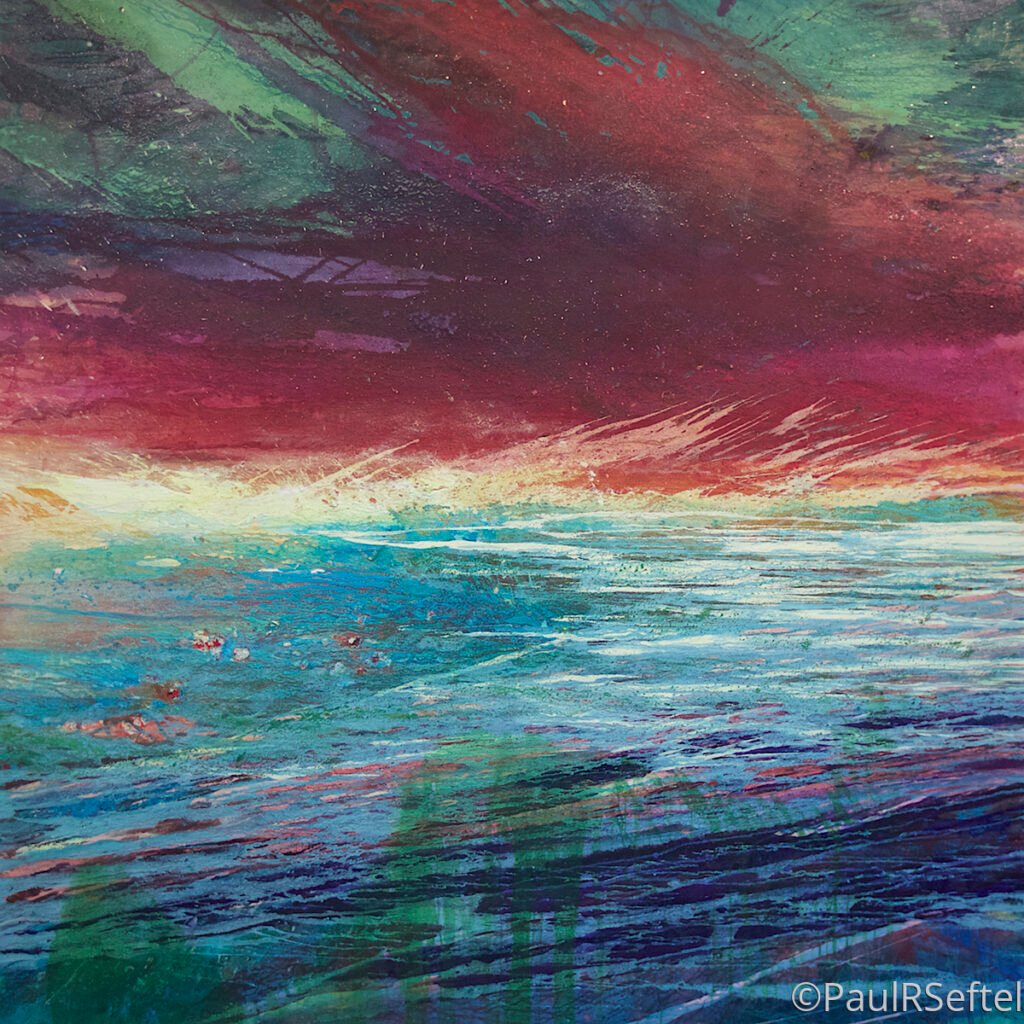
84 x 84 inches
Built through layered mineral pigment, mica and graphite-inflected surface, the work shifts between opacity and luminosity—moving between day and night. It reveals depth gradually while still delivering moments of immediate visual arrest.
The Great Wave
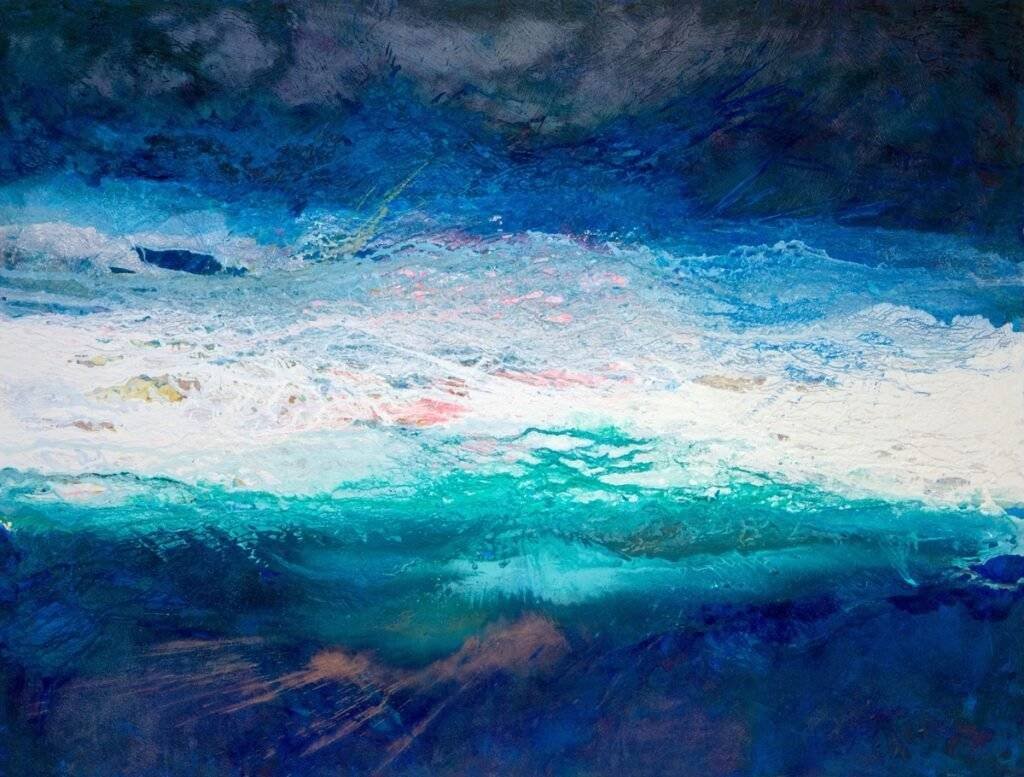
80 x 106 inches
This one moves differently—less held, more kinetic.
Mineral layering of limestone and marble, combined with oxidized metals, graphite and pigment, creates a surface in motion. Blues move through turquoise into deeper tonal fields, while light breaks across the painting, producing moments of intensity and release. The work carries momentum without losing structure.
Waves of Time and Light
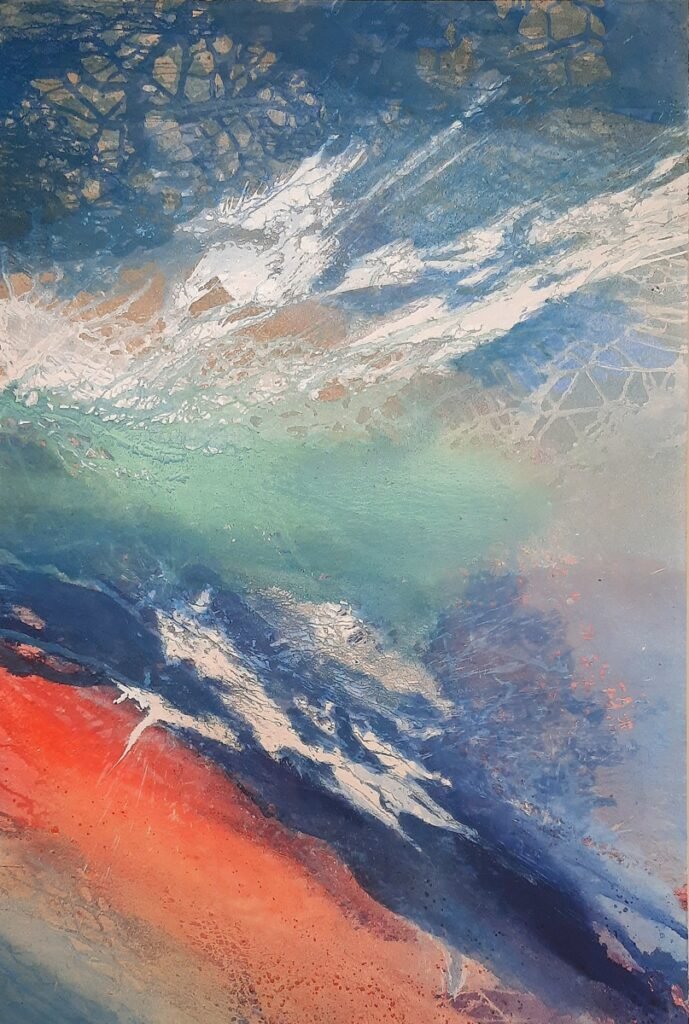
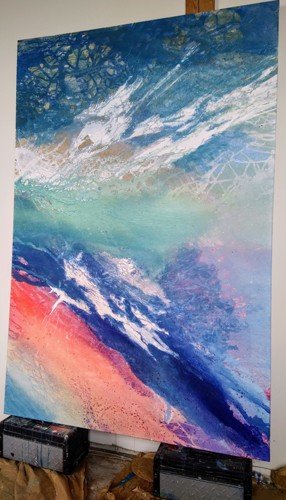
108 x 72 inches
This work extends further into duration.
Layered mineral pigment, limestone, marble and oxidized metal elements create a surface that shifts continuously as light changes. Blues and patinated tones emerge and recede, so the work is never fully fixed. It unfolds over time, particularly in spaces where light variation becomes part of the experience.
Final Thought
Scale gets attention.
What matters is what happens after that.
A painting becomes monumental when it continues to hold—through surface, through light, through time.
That’s not about size.
That’s about what the work is made of, and how long it stays with you.