Layered Landscape Paintings That Redefine Contemporary Art
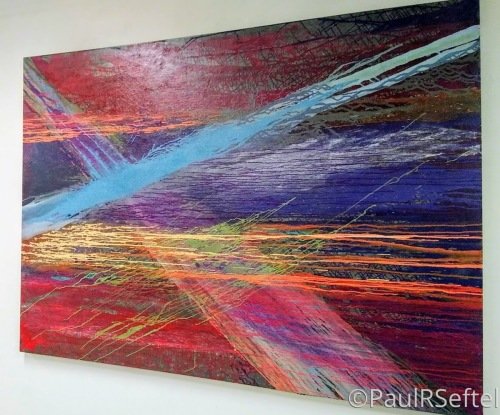
Something happens when an artist stops painting what a place looks like and starts painting what it feels like. These layered landscape paintings go beyond color and form they have gravity, presence, and rhythm. You don’t just look at them; you enter them. You can almost sense the air moving between the strokes.
This new wave of dimensional landscape art has reshaped the contemporary scene. Artists are transforming vistas and skies into emotional geographies where the horizon breathes and the paint itself becomes part of the terrain. This is art that doesn’t politely hang on a wall; it asserts itself. It asks you to feel the world, not just view it.
How Material Depth Transforms the Landscape
In today’s landscape artworks and paintings, surface depth has become a storytelling medium in itself. While traditional landscape artists used perspective and color theory to create illusion, contemporary painters build real, physical space within the paint the kind that shifts with light and mood.
They mix pigments with sand, metal, resin, and organic matter. Think of ridges that mimic riverbeds, or strokes that gather like cloud banks. The play between light and shadow keeps the work alive never static, always in conversation with its environment.
Every painting becomes an ecosystem of its own breathing, shifting, and evolving through time and attention.
The Emotional Pull of Textural Landscape Art
Why do these works feel so alive? Because they mirror the natural contradictions of being human serenity beside chaos, fragility beside force.
When a canvas carries weight, when it holds gesture and matter, it captures more than a scene it carries emotion. These dimensional landscapes remind us that the Earth itself has memory, scars, and energy.
Collectors often describe them as “grounding.” They pull a space into focus, balancing calm and intensity. They make walls hum. They make rooms feel awake.
Artists Who Shaped the Language of Depth
The roots of today’s layered landscape art run deep through artists who used material and gesture to turn land into a living metaphor.
- Anselm Kiefer built landscapes from ash, clay, and lead heavy, historical, and utterly human. His works feel excavated rather than painted, blurring ruin and rebirth.
- El Anatsui turns discarded metal into sprawling fields of light and pattern. His surfaces ripple like woven topographies landscapes of memory and transformation.
- Vincent van Gogh showed us that brushwork could be heartbeat that the land itself could vibrate with feeling. His skies don’t just turn; they ache.
- Claude Monet taught us to see atmosphere that perception itself is a landscape. His water lilies and horizons shift endlessly, like breathing made visible.
Together, they remind us that landscape art is never just about place it’s about experience. Each one used material as language, turning surface into story.
Why Collectors Love Deeply Layered Landscape Paintings
For collectors, these works are more than decoration they’re emotional anchors. Their surface depth gives a room rhythm. They catch and release light differently as the day passes, like living organisms in dialogue with their surroundings.
Why they resonate:
- Tactile allure: These works invite intimacy; they beg a second look.
- Individual character: No repetition, no template just presence.
- Versatility: Dimensional landscapes energize minimalist interiors and soften modern ones.
- Emotional honesty: They connect you directly to the gesture, the impulse, the human behind the paint.
Owning one feels like keeping a fragment of the Earth’s pulse in your home raw, unpredictable, alive.
The Material Renaissance in Contemporary Art
In an age where most images live behind glass, artists are reclaiming the physical. These materially rich landscapes give us something to touch with our eyes, proof that art can still surprise the senses.
They play beautifully against clean architecture and digital design grounding smooth, modern surfaces with something elemental and real. They remind us that art is an act of presence: it slows us down, asks us to look again, and rewards that patience with discovery.
Where to Experience Textural and Layered Landscape Art
Want to experience this kind of work up close? You don’t have to book a flight though we won’t stop you.
Many galleries now curate shows dedicated to this sensory, dimensional approach to landscape. And if you’d rather browse from your sofa, a contemporary art gallery online can bring you closer than ever. High-resolution, zoomable views reveal the ridges, lines, and gestures that make each piece feel alive.
Virtual exhibitions are the new front row no museum hush required.
Final Thoughts
Layered landscape art isn’t a trend; it’s a return to something essential a reconnection between emotion, environment, and the act of creation itself.
By using depth, movement, and material resonance, artists collapse the distance between nature and the viewer. These works remind us that art isn’t meant to imitate life it’s meant to translate it.
Kiefer, Anatsui, Van Gogh, Monet each, in their own way, gave us a language for seeing the world not as image, but as feeling. And that language is still expanding today in studios, in galleries, and on the walls of those brave enough to live with art that refuses to be quiet.