Art of the Stamp: Textural Abstracts for Modern Walls
Ever imagine you can see history in small postage stamps?
These tiny rectangles of propaganda, commemoration, and visual language have been marking time and territory for over a century.
These stamps are more than mail delivery tools; they are themselves pieces of art.
stamp work transforms miniature icons of the past into textured landscapes of the present.
My Art of the Stamp series reimagines these fragments of public memory. I’m not collecting stamps; I’m excavating them —layering them, letting them build surfaces that speak to history, repetition, and the strange poetry of things no longer needed for their original purpose.
Rising Tide
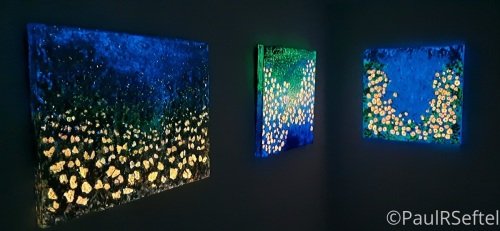
Some pieces feel like they’re moving toward you. Rising Tide is one of those works —an accumulation of stamps arranged and layered until they become waves, or sediment, or maybe the visual record of a civilization trying to document itself into permanence.
The texture is what hits first. Hundreds of stamps, each one a tiny piece of official narrative, overlap and interact.
Colors bleed.
Edges curl.
The flatness of the original material gives way to dimensional complexity. What was once designed to be glued and forgotten becomes the subject itself.
Art of the Stamp works like this, lives in the tension between order and entropy. Stamps were created for bureaucracy, for precision, for control. But when you gather them en masse and let them inform each other, they start to behave like natural systems —unpredictable, organic, alive.
Rising Tide captures that transformation. The piece moves from darker, denser regions into lighter, more fragmented areas. It feels like watching something emerge or dissolve. You can’t quite tell which direction time is moving, and that’s exactly the point.
Golden Frontier
If Rising Tide speaks to accumulation, golden frontier is about illumination. This piece takes the Art of the Stamp approach and pushes it into warmer, more optimistic territory. Golds dominate, punctuated by russets and deep blues.
The stamps here aren’t just layered; they’re transformed. Some are obscured entirely. Others remain partially visible, like memories surfacing and submerging. The overall effect is one of radiance —as if the work itself is generating light rather than merely reflecting it.
Golden Frontier brings that beauty forward. The piece feels expansive despite being built from tiny components. It suggests possibility, optimism, the idea that even obsolete objects can be reborn into new meaning.
This is what makes Art of the Stamp work compelling for modern wall décor: it bridges past and present without sentimentality. It’s not about nostalgia; it’s about transformation. About what happens when you take fragments of official memory and let them speak in new arrangements, new contexts, new conversations.
Why Texture Matters in Contemporary Spaces
Flat walls want for dimension. That’s the truth. We’ve spent decades smoothing, whitewashing, and minimizing surfaces. And while simplicity is elegant, there’s also a hunger for texture —for something the eye can rest on, something that changes as light moves across it.
Textural abstracts for modern wall décor satisfy that hunger. They give architecture its counterpoint. They provide visual weight without adding physical clutter. And when that texture is built from layered materials with their own stories, the effect multiplies.
My Art of the Stamp series understands this. Each piece offers not just visual interest, but actual physical relief. Shadows form in the valleys between stamps. Light catches on their edges. The work shifts throughout the day, revealing different aspects of itself depending on the angle and illumination.
I believe modern wall décor shouldn’t apologize for being interesting. It should command attention, reward sustained looking, and contribute something irreplaceable to its space. The Art of the Stamp works do exactly that —they turn small relics of the postal age into contemporary statements about time, accumulation, and the strange beauty of things that outlive their function.
FAQs
What is stamp work in contemporary art?
Stamp work involves using postage stamps as artistic material rather than functional objects. Artists layer, arrange, and manipulate stamps to create textured abstract compositions. This transforms these tiny pieces of postal history into dimensional artwork that explores themes of accumulation, memory, and cultural iconography. The technique creates unique surface textures impossible to achieve with traditional paint alone.
How is Art of the Stamp different from stamp collecting?
Stamp collecting focuses on preservation, rarity, and cataloging individual specimens. Art of the Stamp repurposes stamps as raw material for contemporary art, often obscuring or transforming their original imagery.
Can textural stamp art work in minimalist modern spaces?
Yes, why not. The textural dimension and historical depth of stamp work provide a perfect contrast to minimalist interiors’ smooth surfaces and clean lines. These pieces add visual interest and tactile complexity without introducing color chaos. They’re particularly effective in spaces that need a focal point with substance —turning blank walls into dimensional surfaces that reward closer inspection while maintaining sophisticated restraint.